Thomas Jefferson: Author of America by Christopher Hitchens
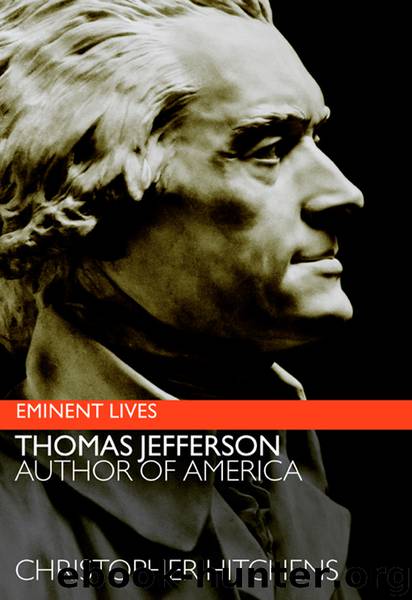
Author:Christopher Hitchens [Hitchens, Christopher]
Language: eng
Format: mobi, epub
ISBN: 9780060837068
Publisher: HarperCollins
Published: 2005-05-31T04:00:00+00:00
Chapter Six
In Waiting
IN RETREAT AT Monticello from the earliest days of 1794, Jefferson may possibly have intended to keep to his retirement. In the fall of that year, he certainly declined an invitation from Edmund Randolph, who had succeeded him as secretary of state. Randolph wanted him to be the negotiator with Spain for a new treaty. Jefferson did not merely refuse the offer but added that no inducement of any kind could tempt him back into politics. Yet it might equally well be argued that he was reserving himself for something more advantageous.
It was during these years that, under the spur of economic exigency, he retrenched and modernized his famous home. He remained an agrarian, in his newly designed plow, modeled on an earth-cutting technique that he had first noticed when in France, and in his importation of a more efficient threshing machine from Scotland. He made some concessions to industrialism by establishing a nail-making factory on the estate and organizing the younger male slaves into a rudimentary production line. A spacious reconstruction of the Palladian house was put in hand, still somewhat revealing to the visitor’s eye in that some of its innovations (the dumbwaiter, the revolving door, the views from the windows) were so arranged as to minimize any direct contact with the slaves themselves.
Having passed the age of fifty while secretary of state, Jefferson was being made a grandfather by the birth of Martha’s children to Thomas Mann Randolph. And he himself became a father once more, with the arrival of Sally Hemings’s first recorded child in 1795. Mentally and physically he remained exceedingly young and hale for his years, and took regular strenuous exercise on horseback and with his trusty gun. How likely is it that he could for long have avoided the political imperative? Only, perhaps, if members of his own political faction had held the upper hand in the nation’s business. But by the closing months of 1794, the news (and his own correspondents) told him that such was not the case. A revolt, known to history as the Whiskey Rebellion because of its protest against a federal excise on liquor-distilling, broke out in western Pennsylvania. The political leadership of this movement, which took its tune from the French Revolution, at one point proposed to call itself a “Committee of Public Safety” along Jacobin lines. George Washington, Alexander Hamilton, John Adams, and John Jay, for their part, had no difficulty in detecting the subversive hand of the recently formed, Republican-leaning “Democratic Societies.” These they darkly termed “self-created societies”—as if there could have been any other kind. The militia was summoned from several adjoining states, and a force of fifteen thousand men, with Hamilton as one of its commanders, was put into the field against the radicals. This exercise in overwhelming authority had the effect of crushing the rebellion with impressive speed.
It also had the effect of outraging Jefferson. In a letter to James Madison, leader of the Republicans in Congress, he characterized the
Download
Thomas Jefferson: Author of America by Christopher Hitchens.epub
This site does not store any files on its server. We only index and link to content provided by other sites. Please contact the content providers to delete copyright contents if any and email us, we'll remove relevant links or contents immediately.
| Africa | Americas |
| Arctic & Antarctica | Asia |
| Australia & Oceania | Europe |
| Middle East | Russia |
| United States | World |
| Ancient Civilizations | Military |
| Historical Study & Educational Resources |
Cat's cradle by Kurt Vonnegut(15446)
Pimp by Iceberg Slim(14678)
4 3 2 1: A Novel by Paul Auster(12517)
Underground: A Human History of the Worlds Beneath Our Feet by Will Hunt(12146)
The Radium Girls by Kate Moore(12095)
Wiseguy by Nicholas Pileggi(5843)
The Fire Next Time by James Baldwin(5506)
Perfect Rhythm by Jae(5470)
American History Stories, Volume III (Yesterday's Classics) by Pratt Mara L(5338)
Paper Towns by Green John(5248)
Pale Blue Dot by Carl Sagan(5083)
A Higher Loyalty: Truth, Lies, and Leadership by James Comey(5018)
The Doomsday Machine by Daniel Ellsberg(4556)
The Mayflower and the Pilgrims' New World by Nathaniel Philbrick(4540)
Killers of the Flower Moon: The Osage Murders and the Birth of the FBI by David Grann(4490)
The Sympathizer by Viet Thanh Nguyen(4447)
Too Much and Not the Mood by Durga Chew-Bose(4388)
The Borden Murders by Sarah Miller(4382)
Sticky Fingers by Joe Hagan(4256)
